Too long didnt write my blog already..
Maybe i am too busy doing my stuffs and also too lazy to write..
In this few months i watched a lot of movies through youtube..
Got vampire movies(林正英),jackie chan movies,stephen chow movies,老夫子 movies and other movies..
林正英
僵尸至尊 (1991年)
灵幻先生 (1987年)
殭屍先生 (1985年)
新僵屍先生 (1992年)
一眉道人 (1989年)
成龍
警察故事(香港電影1985年)
警察故事續集(香港電影1988年)
警察故事3超級警察(香港電影1992年)
重案組(香港電影1993年)
霹靂火 (1995年)
A計劃
周星馳
千王之王 (2000)
逃学威龙1 (1991)
逃学威龙2 (1992)
逃学威龙3之龍過雞年 (1993)
新精武门1991 (1991)
唐伯虎點秋香 (1993)
整蛊专家 (1991)
大話西游之仙履奇緣 (1995)
審死官 (1992)
武狀元蘇乞兒 (1992)
賭俠2之上海灘賭聖老夫子 (1991)
鹿鼎記 (1992)
鹿鼎記2神龍教 (1992)
破壞之王 (1994)
百變星君 (1995)
大內密探零零發(鹿鼎大帝)(1996)
國產凌凌漆(凌凌漆大戰金鎗客) (1994)
九品芝麻官之白面包青天 (1994)
老夫子
魔界梦战记II威武秦王
Old Master
小水虎传奇
水虎傳(香港電影1982年)
经典动画 七彩卡通老夫子
other movies
殺破狼 (粤语) - 洪金寶 任達華 甄子丹 吳京
最佳拍档1 - 光头神探
Vampire.Warriors.2010.BDRE.X264.720p.CN[僵尸新战士].
关云长 - 甄子丹
2012年1月6日星期五

2011年11月28日星期一
The movies I watched
Too long didnt write my blog already..
Maybe i am too busy doing my stuffs and also too lazy to write..
In this few months i watched a lot of movies through youtube..
Got vampire movies(林正英),jackie chan movies,stephen chow movies,老夫子 movies and other movies..
林正英
僵尸至尊 (1991年)
灵幻先生 (1987年)
殭屍先生 (1985年)
新僵屍先生 (1992年)
一眉道人 (1989年)
成龍
警察故事(香港電影1985年)
警察故事續集(香港電影1988年)
警察故事3超級警察(香港電影1992年)
重案組(香港電影1993年)
霹靂火 (1995年)
A計劃
周星馳
九品芝麻官
千王之王 (2000)
逃学威龙1 (1991)
逃学威龙2 (1992)
逃学威龙3之龍過雞年 (1993)
新精武门1991 (1991)
唐伯虎點秋香 (1993)
整蛊专家 (1991)
大話西游之仙履奇緣 (1995)
審死官 (1992)
武狀元蘇乞兒 (1992)
老夫子
魔界梦战记II威武秦王
Old Master
小水虎传奇
水虎傳(香港電影1982年)
经典动画 七彩卡通老夫子
other movies
殺破狼 (粤语) - 洪金寶 任達華 甄子丹 吳京
最佳拍档1 - 光头神探
Vampire.Warriors.2010.BDRE.X264.720p.CN[僵尸新战士].
关云长 - 甄子丹
2010年11月16日星期二
最后一天
昨天是我最后一天去学校读书。。
最后一天跟form 3,form 4和form5的朋友见面。。
最后一天见所有的老师。。
心里难免有些感触,不舍和无奈。。
今天可说是我疯狂的一天。。
我到处走去跟朋友拍照。。
早餐都没吃,就只是顾着拍照。。
拍了四百多张叻。。
多到我难以置信。。
多到我觉得我有点神经病。。
或许,我想拍多点照片来做记念吧!
我不想忘记这些朋友。。
在读Form 6的日子里,我做了pengawas,也认识了很多人。。
所以朋友也多了。。
但最让我开心的是我做了我以前都没有做过的东西。。
比如:做pengawas,参加pembarisan,捐血,参加camp,还有其他。。
这样会让我的生活过得更充实。。
STPM就要到了。。
虽然它是下个星期才开始,但我总觉得它好像明天就开始了。。
我真的蛮希望我的考试能考得好。。
朋友们,你们也要为你们的考试加油。。
Gambateh..
2010年10月23日星期六
黃韻玲-喜歡你現在的樣子
我就是喜歡你現在的樣子
我就是喜歡你這樣的脾氣
有時善解人意 有時粗心大意
我 就是喜歡你現在的樣子
我真的喜歡你現在的樣子
我真的喜歡你這樣的 任性
有時千言萬語 有時不說一句
我真的喜歡你現在的樣子
不要輕異嚐試任何改變
改變你現在所有的一切
以為我能再多愛你一些
不要懷疑自己
屬於你的一切都是美麗
我相信 只有真心能永遠
我就是喜歡你現在的樣子
我就是喜歡你這樣的脾氣
有時善解人意 有時粗心大意
我 就是喜歡你現在的樣子
不要輕異嚐試任何改變
改變你現在所有的一切
以為我能再多愛你一些
不要懷疑自己
屬於你的一切都是美麗
我相信 只有真心能永遠
不變~
我就是喜歡你現在的樣子
我就是喜歡你這樣的脾氣
有時善解人意 有時粗心大意
我 就是喜歡你現在的樣子
不要隨便 改變你現在的樣子
2010年10月13日星期三
今天重新写会我的blog
今天刚刚考了muet的speaking。。
当考试时,真的有点紧张。。
我觉得我的表现不是很好,有点失望。。
考了后就可以回家了。。
可是,我还需要从老师那边拿surat给guard才可以回。。
真的是多此一举。。
现在STPM还有42天就到了。。
我要加紧努力读书。。
不然,成绩肯定像鬼。。
唉。。
張洪量-妳知道我在等妳嗎
莫名我就喜歡妳 深深地愛上妳
沒有理由 沒有原因
莫名我就喜歡妳 深深地愛上妳
從見到妳的那一天起
妳知道我在等妳嗎 妳如果真的在乎我
又怎會讓無盡的夜陪我度過
妳知道我在等妳嗎 妳如果真的在乎我
又怎會讓握花的手在風中顫抖
莫名我就喜歡妳
深深地愛上妳
在黑夜裡傾聽妳的聲音
New Order-Bizarre Love Triangle
Everytime I think of you
I feel shot right through
with a bow of gloom.
It's no problem of mine
but it's a problem I find
living a life that I can't leave behind.
There's no sense in telling me
the wisdom of a fool won't set you free.
But that's the way that it goes
and it's what nobody knows
while every day my confusion grows.
Everytime I see you falling
I get down on my knees and pray
I'm waiting for that final moment
you'll say the words that I can't say.
I feel fine ans I feel good
I'm feeling like nobody should.
When ever I get this way
I just don't know what to say.
Why can't we be ourselves
like we were yesterday.
I'm not sure what this could mean.
I don't think you're what you seem.
I do admit to myself
that if I hurt someone else
then I'll never see just what we're ment to be.
Everytime I see you falling
I get down on on my knees and pray.
I'm waiting for that final moment
you'll say the words that I can't say.
Everytime I see you falling
I get down on my knees and pray.
I'm waiting for that final moment
you'll say the words that I can't say.
2010年10月11日星期一
Damien Rice-The Blower's Daughter
And so it is
Just like you said it would be
Life goes easy on me
Most of the time
And so it is
The shorter story
No love, no glory
No hero in her sky
I can't take my eyes off of you
I can't take my eyes off you
I can't take my eyes off of you
I can't take my eyes off you
I can't take my eyes off you
I can't take my eyes...
And so it is
Just like you said it should be
We'll both forget the breeze
Most of the time
And so it is
The colder water
The blower's daughter
The pupil in denial
I can't take my eyes off of you
I can't take my eyes off you
I can't take my eyes off of you
I can't take my eyes off you
I can't take my eyes off you
I can't take my eyes...
Did I say that I loathe you?
Did I say that I want to
Leave it all behind?
I can't take my mind off of you
I can't take my mind off you
I can't take my mind off of you
I can't take my mind off you
I can't take my mind off you
I can't take my mind...
My mind...my mind...
'Til I find somebody new
2010年10月6日星期三
动力火车-你快乐所以我快乐
你眉頭開了 所以我笑了
你眼睛紅了 我的天灰了
啊 天曉得 既然說
你快樂 於是我快樂
玫瑰都開了 我還想怎麼呢
求之不得 求不得
天造地設一樣的難得
喜怒和哀樂 有我來重蹈你覆徹
LA LA LA…… LA LA LA……
你眉頭開了
我的天灰了
你眼睛紅了
所以我笑了
啊 天曉得 既然說
你快樂 於是我快樂
玫瑰都開了 我還想怎麼呢
求之不得 求不得
天造地設一樣的難得
喜怒和哀樂 有我來重蹈你覆徹
LA LA LA…… LA LA LA……
2010年8月8日星期日
The worst car accident happenned in my life


I met a car accident on Friday..
I was not going tuition in Kasturi that day because Saturday i dont have school..
Normally if Saturday got school,i will take tuition on Friday evening..
So i planned to go tuition on Saturday morning..
But i faced the worst car accident that happened in my life..
That time i was going home from school after watched two semi-final form 4 interclass basketball games..
I stopped behind a car which is a BMW at the traffic light..
Suddenly a Proton Wira bang my car from behind..
I can feel a force push my car towards..
Although i stepped on my brek already,my car still move forward and bang the BMW..
My car damaged until so terrible and serious..
The front part and the back part very serious..
But the back part still ok,whereas the front part so terrible..
Then i stopped my car then called my dad to come..
The Proton Wira driver is a 20 something years old Indian,however the BMW is 40 years old Chinese..
The Chinese asked us to sit his car first and went to a safety place first,because It is not safety on the road..
The Indian called his brother to come..
The Chinese asked his insuran agent how to settle the problem..
Wait for a while,my dad came..
After discussed,we decide to report this accident to police..
Because if we make a police report,then our cars can claim insurans..
We went to the police station which near Petaling Street..
Actually the process of making a police report is not difficult and wont take time so much..
I think around half an hour can finish it..
Maybe that time still not many people come and make report yet..
Then i saw the sarjan police,he is a Chinese which with the surname Lau..
He asked me the process of the car accident happened and which part of my car damaged..
And,the Indian driver get the saman..
He keep on say sorry to me and my dad..
I think i will forgive him because who also dont hope car accident happened de..
Therefore,my car send to repair..
I think at least one month i dont have car to use,cannot drive car to school..
My mum will fetch me to school..
Haiz..:(
2010年7月14日星期三
Congrats Melvin,Timothy and Siong Juun..Finally they have their beloved girlfriend..
Congrats Melvin,Timothy and Siong Juun..
Finally they have their beloved girlfriend..
Especially Timothy..
He had surprised me..
I think many people will feel surprise also when heard this news..
But i feel that it is good for him..
This is the new starting for him..
Having a girlfriend maybe can make him to become more mature..
Everyone have the same chance to get the true love..
It is fair to everyone..
He is the one also..
Although i know that there are many people dont like him,he still is my friend..
There are not many prefects have his semangat pengawas..
Even my semangat is not more than him also..
He had always done a good job..
Dont judge the book by its cover..
He has his own good side to attract the girls also..
So for me,i feel glad to listen to this news..
Let me talk about my another friend,Siong Juun..
Although sometimes i dont like his attitude,sometimes i argue with him,sometimes i talk bad about him,he is one of my good friend..
We had being in the same class three years already,3A12 until 5A12..
He always zat me also..
So every times i dont like him to disturb me..
When he is in the relationship with Caster Woo that time,honestly i feel shocked also..
Because i thought he will focus on his study..
Study put in the first place..
But he had surprised me..
I feel that he is a good guy..
Although his mouth always talk the sweet things to girl and very talkative,he is a serious guy also..
When he have a project to do or an activity to organise,he definitely responsible on it and manage to do it as well..
So i trust that he is a responsible guy..
Having a pretty girlfriend is the best award for him..
Siong Juun,when you marry that time,dont forget to invite me to come ah..Haha..
Every relationship need some patience to maintain it..
I hope they will maintain their relationship with their girlfriend until forever..
For me,by right now,i wont think about this kind of things..
Because there are still got many things i havent do yet..
Especially STPM..
It will affect my future and my whole form 6 life..
So i cannot fail my exam..
Hope i can get a good result gua..
2010年7月4日星期日
Moa


The moa were eleven species (in six genera) of flightless birds endemic to New Zealand. The two largest species, Dinornis robustus and Dinornis novaezelandiae, reached about 3.7 m (12 ft) in height with neck outstretched, and weighed about 230 kg (510 lb).
Moa are members of the order Struthioniformes (or ratites) although some sources also recognise these as the separate order Dinornithiformes. The eleven species of moa are the only wingless birds, lacking even the vestigial wings which all other ratites have. They were the dominant herbivores in New Zealand forest, shrubland and subalpine ecosystems for thousands of years, and until the arrival of the Māori were hunted only by the Haast's Eagle. All species are generally believed to have become extinct by 1500 AD, mainly due to hunting by Māori.
The moa's only predator was the massive Haast's Eagle—until the arrival of human settlers.
The Māori arrived sometime before A.D. 1300, and all moa genera were soon driven to extinction by hunting and, to a lesser extent, forest clearance. By about A.D. 1400 all moa are generally thought to have become extinct, along with the Haast's Eagle which had relied on them for food. Recent research using carbon-14 dating of middens strongly suggests that this took less than a hundred years; rather than the period of exploitation lasting several hundred years which had been earlier believed.
Some authors have speculated that a few Megalapteryx didinus may have persisted in remote corners of New Zealand until the 18th and even 19th centuries, but the view is not widely accepted. Some Māori hunters claimed to be in pursuit of the moa as late as the 1770s. Whalers and sealers recalled seeing monstrous birds along the coast of the South Island, and in the 1820s a man named George Pauley made an unverified claim of seeing a moa in the Otago Region of New Zealand. An expedition in the 1850s under Lieutenant A. Impey reported two Emu-like birds on a hillside, on the South Island, and an 1861 story from the Nelson Examiner told of three-toed footprints measuring 36 centimetres (14 in) between Takaka and Riwaka, found by a surveying party, and finally in 1878 the Otago Witness published an account from a farmer and his shepherd.
Though scientists agree there is no doubt that moa are extinct, there has been occasional speculation—since at least the late 1800s, and as recently as 2008—that some moa may still exist, particularly the rugged wilderness of South Westland and Fiordland. Cryptozoologists and others reputedly continue to search for them, but their claims and supporting evidence (such as of purported Moa footprints or blurry photos) have earned little attention from mainstream experts, and are widely considered pseudoscientific.
Experts contend that moa survival is extremely unlikely, since this would involve the ground-dwelling birds living unnoticed in a region visited often by hunters and hikers.
While the rediscovery of the Takahē in 1948 (after none had been seen since 1898), showed that rare birds may exist undiscovered for a long time, the Takahē was rediscovered after its tracks were identified—yet no reliable evidence of moa tracks has ever been found. The Takahē is also a much smaller bird.
A 2010 episode of the paranormal television program Destination Truth featured a search for the giant moa.
2010年7月3日星期六
Quagga


The quagga (Equus quagga quagga) is an extinct subspecies of the Plains zebra,which was once found in great numbers in South Africa's Cape Province and the southern part of the Orange Free State. It was distinguished from other zebras by having the usual vivid marks on the front part of the body only. In the mid-section, the stripes faded and the dark, inter-stripe spaces became wider, and the rear parts were a plain brown. The name comes from a Khoikhoi word for zebra and is onomatopoeic, being said to resemble the quagga's call. The only quagga to have been photographed alive was a mare at the Zoological Society of London's Zoo in Regent's Park in 1870.
The quagga lived in the drier parts of South Africa, on grassland. The northern limit seems to have been the Orange River in the west and the Vaal River in the east; the south-eastern border may have been the Great Kei River. It was hunted for its meat and hide, and is one of the many victims of modern mass extinction.
The quagga was originally classified as an individual species, Equus quagga, in 1778. Over the next 50 years or so, many other zebras were described by naturalists and explorers. Because of the great variation in coat patterns (no two zebras are alike), taxonomists were left with a great number of described "species", and no easy way to tell which of these were true species, which were subspecies, and which were simply natural variants.
Long before this confusion was sorted out, the quagga had been hunted to extinction for meat, hides, and to preserve feed for domesticated stock. The last wild quagga was probably shot in the late 1870s, and the last specimen in captivity, a mare, died on August 12, 1883 at the Artis Magistra zoo in Amsterdam. Because of the confusion between different zebra species, particularly among the general public, the quagga had become extinct before it was realized that it appeared to be a separate species.
The quagga was the first extinct creature to have its DNA studied. Recent genetic research at the Smithsonian Institution has demonstrated that the quagga was in fact not a separate species at all, but diverged from the extremely variable plains zebra, Equus burchelli, between 120,000 and 290,000 years ago, and suggests that it should be named Equus burchelli quagga. However, according to the rules of biological nomenclature, where there are two or more alternative names for a single species, the name first used takes priority. As the quagga was described about thirty years earlier than the plains zebra, it appears that the correct terms are E. quagga quagga for the quagga and E. quagga burchelli for the plains zebra, unless "Equus burchelli" is officially declared to be a nomen conservandum.
After the very close relationship between the quagga and surviving zebras was discovered, the Quagga Project was started by Reinhold Rau in South Africa to recreate the quagga by selective breeding from plains zebra stock, with the eventual aim of reintroducing them to the wild. This type of breeding is also called breeding back. In early 2006, it was reported that the third and fourth generations of the project have produced animals which look very much like the depictions and preserved specimens of the quagga, though whether looks alone are enough to declare that this project has produced a true "re-creation" of the original quagga is controversial.
DNA from mounted specimens was successfully extracted in 1984, but the technology to use recovered DNA for breeding does not yet exist. In addition to skins such as the one held by the Natural History Museum in London, there are 23 known stuffed and mounted quagga throughout the world. A twenty-fourth specimen was destroyed in Königsberg, Germany (now Kaliningrad), during World War II.
2010年6月26日星期六
Suddenly i feel i am useless..
Actually today and yesterday i really so unhappy..
I found that there are something i cannot do..
I cant even my sis to get what she wants..
I know she hoped to have it since form 1..
She really wish for a miracle..
But i cant do anything..
I suddenly feel that i am so useless..
A small matter also cannot help her..
She is my sis..
What she wants,i am brother de sure will know..
I really understand her feelings..
If you see her best friends all can get it except her..
How she will feel?
Sure sad and no mood de..
But what can i do?
I feel so sorry to her..
But i promise i will try my best to help her..
I will take time to settle it..
Thanks for Jia Jie for chatting with me..
Because of you,i feel quite ok now..
You are always my good friend..
At here,I would like to congrats the one who get the AJK post..
Hope you all can do your job as well after i bersara that time..
And,i hope that our school displin will improve next year..
It is a hard time to improve school displin..
But i trust you all can de..Jia You..
Dodo


The dodo (Raphus cucullatus) was a flightless bird endemic to the Indian Ocean island of Mauritius. Related to pigeons and doves, it stood about a meter (3 feet) tall, weighing about 20 kilograms (44 lb), living on fruit, and nesting on the ground.
The dodo has been extinct since the mid-to-late 17th century.It is commonly used as the archetype of an extinct species because its extinction occurred during recorded human history and was directly attributable to human activity.
The phrase "dead as a dodo" means undoubtedly and unquestionably dead, whilst the phrase "to go the way of the dodo" means to become extinct or obsolete, to fall out of common usage or practice, or to become a thing of the past.
As with many animals that have evolved in isolation from significant predators, the dodo was entirely fearless of people, and this, in combination with its flightlessness, made it easy prey for humans.However, journals are full of reports regarding the bad taste and tough meat of the dodo, while other local species such as the Red Rail were praised for their taste. When humans first arrived on Mauritius, they also brought with them other animals that had not existed on the island before, including dogs, pigs, cats, rats, and Crab-eating Macaques, which plundered the dodo nests, while humans destroyed the forests where the birds made their homes;currently, the impact these animals—especially the pigs and macaques—had on the dodo population is considered to have been more severe than that of hunting. The 2005 expedition's finds are apparently of animals killed by a flash flood; such mass mortalities would have further jeopardized a species already in danger of becoming extinct.
Although there are scattered reports of mass killings of dodos for provisioning of ships, archaeological investigations have hitherto found scant evidence of human predation on these birds. Some bones of at least two dodos were found in caves at Baie du Cap which were used as shelters by fugitive slaves and convicts in the 17th century, but due to their isolation in high, broken terrain, were not easily accessible to dodos naturally.
There is some controversy surrounding the extinction date of the dodo. Roberts & Solow state that "the extinction of the Dodo is commonly dated to the last confirmed sighting in 1662, reported by shipwrecked mariner Volkert Evertsz" (Evertszoon), but many other sources suggest the more conjectural date of 1681. Roberts & Solow point out that because the sighting prior to 1662 was in 1638, the dodo was likely already very rare by the 1660s, and thus a disputed report from 1674 cannot be dismissed out-of-hand.Statistical analysis of the hunting records of Isaac Johannes Lamotius give a new estimated extinction date of 1693, with a 95% confidence interval of 1688 to 1715. Considering more circumstantial evidence such as travelers' reports and the lack of good reports after 1689,it is likely that the dodo became extinct before 1700; the last Dodo died a little more than a century after the species' discovery in 1581.
Few took particular notice of the extinct bird. By the early 19th century it seemed altogether too strange a creature, and was believed by many to be a myth. With the discovery of the first batch of dodo bones in the Mauritian swamp, the Mare aux Songes, and the reports written about them by George Clarke, government schoolmaster at Mahébourg, from 1865 on,interest in the bird was rekindled. In the same year in which Clarke started to publish his reports, the newly vindicated bird was featured as a character in Lewis Carroll's Alice's Adventures in Wonderland. With the popularity of the book, the dodo became a well-known and easily recognizable icon of extinction.
Mammoth


A mammoth is any species of the extinct genus Mammuthus. These proboscideans are members of Elephantidae, the family of elephants and mammoths, and close relatives of modern elephants. They were often equipped with long curved tusks and, in northern species, a covering of long hair. They lived from the Pliocene epoch from around 4.8 million to 4,500 years ago.The word mammoth comes from the Russian мамонт mamont, probably in turn from the Vogul (Mansi) language, mang ont, meaning "earth horn".
The woolly mammoth was the last species of the genus. Most populations of the woolly mammoth in North America and Eurasia, as well all the Columbian mammoths in North America, died out around the time of the last glacial retreat, as part of a mass extinction of megafauna in northern Eurasia and the Americas. Until recently, it was generally assumed that the last woolly mammoths vanished from Europe and southern Siberia about 10,000 BC, but new findings show that some were still present there about 8,000 BC. Only slightly later, the woolly mammoths also disappeared from continental northern Siberia.A small population survived on St. Paul Island, Alaska, up until 3,750 BC,and the small mammoths of Wrangel Island survived until 1,650 BC.
A definitive explanation for their mass extinction is yet to be agreed upon. The warming trend (Holocene) that occurred 12,000 years ago, accompanied by a glacial retreat and rising sea levels, has been suggested as a contributing factor. Forests replaced open woodlands and grasslands across the continent. The available habitat may have been reduced for some megafaunal species, such as the mammoth. However, such climate changes were nothing new; numerous very similar warming episodes had occurred previously within the ice age of the last several million years without producing comparable megafaunal extinctions, so climate alone is unlikely to have played a decisive role.The spread of advanced human hunters through northern Eurasia and the Americas around the time of the extinctions was a new development, and thus probably contributed significantly.
Whether the general mammoth population died out for climatic reasons or due to overhunting by humans is controversial. Another theory suggests that mammoths may have fallen victim to an infectious disease. A combination of climate change and hunting by humans has been suggested as the most likely explanation for their extinction.
Data derived from studies done on living elephants suggests human hunting was likely a strong contributing factor in the mammoth's final extinction[citation needed]. Homo erectus is known to have consumed mammoth meat as early as 1.8 million years ago.
However, the American Institute of Biological Sciences also notes that bones of dead elephants, left on the ground and subsequently trampled by other elephants, tend to bear marks resembling butchery marks, which have previously been misinterpreted as such by archaeologists[citation needed].
The survival of the dwarf mammoths on Russia's Wrangel Island was due to the island's very remote location and lack of inhabitants in the early Holocene period[citation needed]. The European discovery of the island (by American whalers) did not occur until the 1820s[citation needed]. A similar dwarfing occurred with the Pygmy Mammoth on the outer Channel Islands of California, but at an earlier period. Those animals were very likely killed by early Paleo-Native Americans, and habitat loss caused by a rising sea level that split Santa Rosae into the outer Channel Islands[citation needed].
Recent research indicates that mammoths survived in the Americas until 10,000 years ago. This conclusion is from research, by James Haile and Eske Willerslev of the University of Copenhagen, of sediments found in central Alaska, and reported in the Proceedings of the National Academy of Sciences.
2010年6月15日星期二
Jaekelopterus rhenaniae
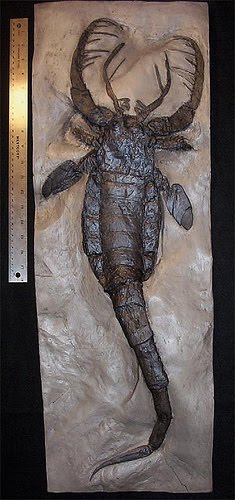

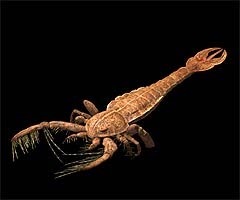


Jaekelopterus rhenaniae ("Otto Jaekel's wing from the Rhineland") is an extinct species of the Eurypterida (sea scorpions). At an estimated length of 2.5 meters (8.2 feet), it is one of the two largest arthropods ever discovered (the other is a giant millipede-like animal, Arthropleura, although which animal was larger is unclear, as well as the other eurypterid Pterygotus). It lived approximately 390 million years ago. Although called a "sea scorpion", it is speculated to have lived in fresh water rivers and lakes, and not in saltwater seas. The animal was described by Simon Braddy and Markus Poschmann of the University of Bristol in the journal Biology Letters (November 2007); they found a 46 cm chelicera (claw-like mouth part), and estimated the total size of the animal based on the proportions of this claw.
The animal's fossilized remains were discovered in the Early Devonian (Emsian) Klerf Formation Lagerstätte of Willwerath near Prüm, Germany.
Arthropleura


Arthropleura (Greek for "Rib Joint') was a 0.3–2.6 metre (1–8.5 feet) long relative of centipedes and millipedes, native to the Upper Carboniferous (340-280 million years ago) of what is now northeastern North America and Scotland. It is the largest known land invertebrate of all time, and would have had few predators.
What Arthropleura ate is a matter of debate among scientists, as none of the fossils have the mouth preserved. However, it is reasonably certain that it would have had a sharp and powerful set of jaws. Based on this assumption, it used to be thought that Arthropleura was carnivorous, but recently discovered fossils have been found with pollen in the gut, suggesting that the creature ate plants. It is possible that the smaller Arthropleura species were vegetarian, while the largest ones were omnivorous, using their jaws to tackle vegetation, as well as to hunt small animals and insects. It is estimated that the average Arthropleura could have eaten its way through a ton of vegetation a year.[citation needed]
Fossilized footprints from Arthropleura have been found in many places. These appear as long, parallel rows of small prints, which show that it moved quickly across the forest floor, swerving to avoid obstacles, such as trees and rocks. When moving at speed, its body would stretch and become longer, giving it a greater stride length and thus allowing it to move faster.[citation needed]
As it moved about, Arthropleura would have brushed against many different types of plant, and may have helped the forest reproduce by moving pollen or spores about the place. It is also thought that Arthropleura was capable of travelling under water, and that it may have returned to lakes and rivers in order to moult its shell. This would have made it vulnerable to attack by large fish and amphibians. On land an adult Arthropleura would have had few enemies.
Arthropleura evolved from crustacean-like ancestors in the Carboniferous, and was able to grow larger than modern arthropods, partly because of the high percentage of oxygen in Earth's atmosphere at that time, and because of the lack of large terrestrial vertebrate predators. Fossil tracks of an arthropod dating back to the Silurian are sometimes attributed to either Arthropleura, or a Silurian- to Early-Devonian millipede called Eoarthropleura. Arthropleura became extinct at the start of the Permian period, when the moist climate began drying out, destroying the rainforests of the Carboniferous, and allowing the desertification characteristic of the Permian. Because of this, oxygen levels in the atmosphere began to decline to more modest levels. None of the giant arthropods could survive the new dry, lower-oxygen climate. Its tracks have the ichnotaxon name Diplichnites cuithensis.
订阅:
博文 (Atom)